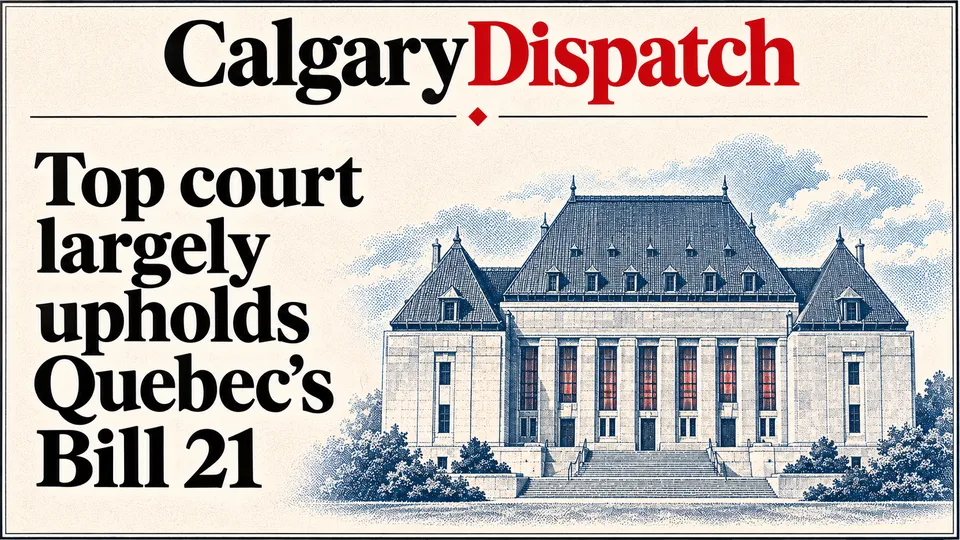
A landmark Supreme Court of Canada decision concerning Quebec's secularism law could have significant consequences for constitutional disputes in Alberta. In a judgment released Friday, November 27, the country's highest court upheld most of Quebec's Bill 21 while clarifying the extent to which legislatures can use the notwithstanding clause to protect legislation from constitutional invalidation. The decision also preserves an important role for courts in examining whether protected legislation conflicts with individual rights.
Quebec's 2019 legislation restricts the wearing of religious symbols by certain public employees, including teachers and police officers. The province invoked constitutional override provisions to protect the legislation from particular rights-based challenges. The Supreme Court concluded that Quebec had validly exercised those powers and rejected arguments seeking to invalidate the legislation on several other constitutional grounds.
However, the court determined that one provision infringed democratic rights insofar as it prevented elected members of Quebec's National Assembly from participating while wearing religiously required face coverings. Democratic rights are not among the Charter protections that legislatures can override through Section 33. The ruling reinforces the distinction between constitutional rights covered by the notwithstanding clause and those that remain fully enforceable regardless of its invocation.
One of the decision's most consequential findings for Alberta concerns judicial declarations. The Supreme Court confirmed that invoking the notwithstanding clause does not necessarily prevent a court from declaring legislation inconsistent with Charter rights. Such a declaration would differ from an order invalidating the legislation: the law could continue operating while the courts formally identify its constitutional consequences. The Supreme Court did not issue such a declaration concerning the overridden rights in the Quebec case itself.
Alberta invoked Section 33 in its October 2025 Back to School Act, which ended the province-wide teachers' strike and imposed collective agreement terms. The province subsequently used the clause in legislation affecting transgender youth. University of Calgary legal scholarship published earlier this year identified unresolved questions about how courts might review those laws despite the constitutional override. Friday's decision provides additional authoritative guidance, although it does not itself resolve any specific challenge to Alberta legislation.
Supporters of the notwithstanding clause argue that it preserves the ability of elected legislatures to make consequential public policy decisions while remaining accountable to voters. Critics contend that pre-emptive use of the provision can weaken judicial protection for minorities and other affected groups. The Supreme Court's recognition of declaratory remedies creates an important distinction between permitting legislation to continue operating and preventing courts from examining its compatibility with constitutional rights.
The ruling also has relevance to Alberta's ongoing electoral boundaries dispute. Section 33 cannot override the Charter's democratic rights protections, meaning the decision should not be interpreted as providing the province with blanket authority to shield electoral legislation from constitutional review. For Albertans, the practical consequences will become clearer as lawyers, advocacy organizations and courts examine how the Supreme Court's reasoning applies to existing and future provincial legislation.
Sources: Supreme Court of Canada: 2026 SCC 41, case summary · Alberta: Back to School Act background