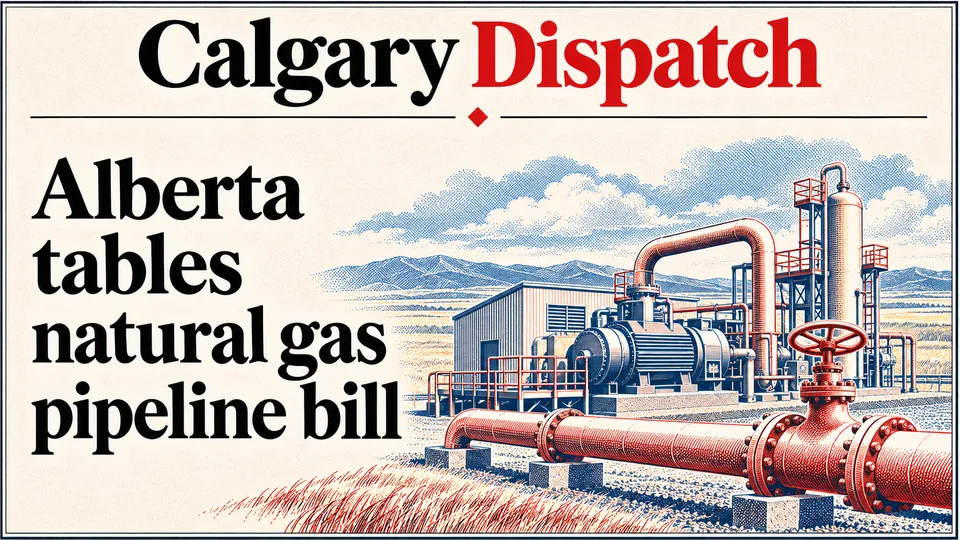
Alberta has introduced legislation that could significantly expand the provincial government's role in natural gas transmission, including the possibility of publicly owned pipeline infrastructure. Energy and Minerals Minister Brian Jean tabled Bill 45, the Natural Gas Infrastructure Act, on Monday, November 23, amid concerns that existing transmission capacity may not expand quickly enough to accommodate growing industrial demand. The legislation completed first reading Monday afternoon and has not become law.
The proposed framework would give Alberta greater influence over infrastructure planning and potentially allow provincial entities to participate directly in pipeline development. The Alberta Utilities Commission could also receive expanded authority concerning necessary transmission capacity. Provincial officials emphasized that the legislation would not immediately establish a Crown corporation, approve a specific pipeline or authorize construction funding. Additional decisions would be required before the government could undertake a development project.
The legislation places the province in a potentially significant disagreement with Calgary-based TC Energy, whose NOVA Gas Transmission system is central to Western Canada's natural gas transportation network. In a November 21 letter obtained by The Narwhal and The Hub, company president and CEO François Poirier warned that changes undermining the existing integrated transmission arrangements could discourage investment and jeopardize recently announced expansion opportunities. TC Energy subsequently confirmed that it was reviewing the legislation and assessing its implications.
Only one week earlier, TC Energy announced plans for the Alberta Growth Connector, a proposed 370-kilometre pipeline connecting Western Canadian gas supplies with Alberta's oilsands region. The company's forecast anticipates demand on its network increasing from 14.4 billion cubic feet per day in 2026 to approximately 18 billion by 2031. TC Energy is also considering new transportation commitments that could support more than 1.3 billion cubic feet per day of additional delivery capacity between 2030 and 2032. Those developments remain subject to commercial arrangements, regulatory approvals and investment decisions.
The province and TC Energy appear to differ over when additional capacity should be developed and how investment risks should be allocated. Alberta wants infrastructure available to support future oilsands expansions, electricity generation, petrochemical manufacturing and artificial intelligence data centres. Pipeline operators generally seek sufficient evidence of customer demand before committing capital to major expansions. Building capacity earlier could help attract industrial projects, but it could also leave infrastructure underutilized if anticipated customers fail to proceed.
The potential consequences for households are less straightforward than either increased capacity or government participation might initially suggest. Greater transmission availability could improve access to gas in constrained areas. However, stronger industrial demand, construction financing arrangements and changes to regulated transportation charges could produce offsetting effects. The legislation does not establish a guaranteed reduction in residential natural gas prices.
For Calgary's energy sector, Bill 45 represents a potentially important change in the relationship between provincial industrial policy and privately financed infrastructure. Its long-term significance will depend on the final legislation, the infrastructure designated under it, the treatment of existing regulatory arrangements and whether Alberta ultimately commits public capital to pipeline development. TC Energy's response following its review will be another important indicator of how the new framework could affect investment.
Sources: Legislative Assembly bill tracker · The Narwhal reporting and letter