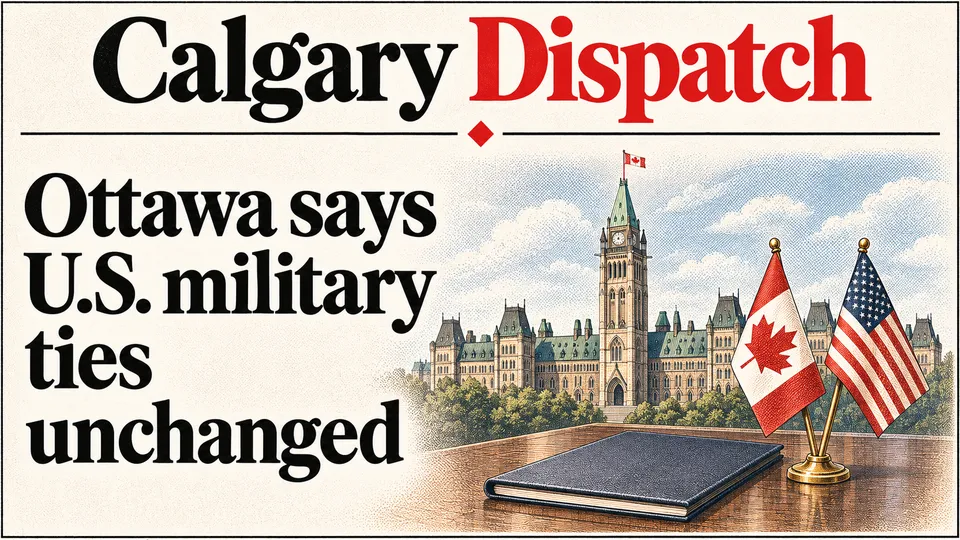
Canadian defence officials say they have seen no change in day-to-day military co-operation with the United States after a reported secret Pentagon directive restricting some defence contacts with Canada. The Washington Post reported late Friday that U.S. Secretary of War Pete Hegseth circulated the classified memorandum last week. Defence Minister David McGuinty, speaking Saturday at the Halifax International Security Forum, said it was the first Ottawa had heard of the document and that he had not seen its contents.
“It’s the first time we heard of this — just yesterday,” McGuinty said. “It’s clear there’s some sort of document we haven’t seen.” He said the two militaries continue to work “hand-in-glove,” including on efforts to stop the flow of illegal drugs in the Caribbean and on integrated air and missile defence, and described the situation as “business as usual.” McGuinty said he had not yet contacted Hegseth, and declined to speculate on what may have prompted the memo, saying Canada has learned to take unexpected decisions from the Trump administration “in stride.”
A Republican senator in Halifax confirmed that the memo exists but played down its operational effect. Sen. Mike Rounds, a member of the Senate Armed Services Committee, said the directive “does limit general flag officer meetings to those that advance [U.S. Department of War] objectives,” and that U.S. defence officials must seek permission before attending social events or think-tank conferences. He said the measures were drafted months ago and signed only recently, and that the intent was to put pressure on Canada over defence spending. After being briefed, he said, the U.S. delegation had heard Ottawa’s “roadmap” to significantly increase that spending.
Democratic Sen. Chris Coons of Delaware, also in Halifax, called the directive “a completely unnecessary insertion of a negative tone.” He said he was relieved it appeared to have “no significant operational impact,” but argued the United States “should be doing nothing to further aggravate” divisions with Canada at a time when adversaries are working more closely together.
In a statement to CBC News, Pentagon spokesperson Sean Parnell said the Department of War is “taking steps to ensure its engagements with Canada advance tangible U.S. defence objectives and ultimately support a reinvigorated defence relationship.” He said the guidance “does not impact defence intelligence co-operation, our binational NORAD command or our co-operation through NATO.” The statement left open questions about bilateral exercises, training exchanges and defence planning. Three Canadian defence officials, speaking on background, told CBC News they were trying to substantiate the reports but had seen no change at the operational level, including in the week since the memo was said to have been circulated.
The report lands on already strained ground. Washington last spring paused participation in the Permanent Joint Board on Defence, a bilateral advisory group that dates to the 1940s, accusing Canada of not making enough progress on its commitments. Canada has now reached NATO’s target of spending two per cent of GDP on defence, but Prime Minister Mark Carney has also said Ottawa should diversify where it buys military equipment, arguing it is unwise for more than 70 cents of every defence-equipment dollar to go to a single market — the United States.
McGuinty announced separately on Saturday that Canada has formally joined the NATO Innovation Fund, becoming the 25th allied backer and the first in North America. Ottawa is contributing more than $100 million — EUR 64.59 million, according to the Business Development Bank of Canada, which will manage the investment — to the multi-sovereign venture fund, which invests in emerging defence and security technologies. The two announcements, one about reported restrictions and the other about a new opening to European allies, underline how Canada is trying to keep the NORAD relationship intact while widening its defence partnerships.