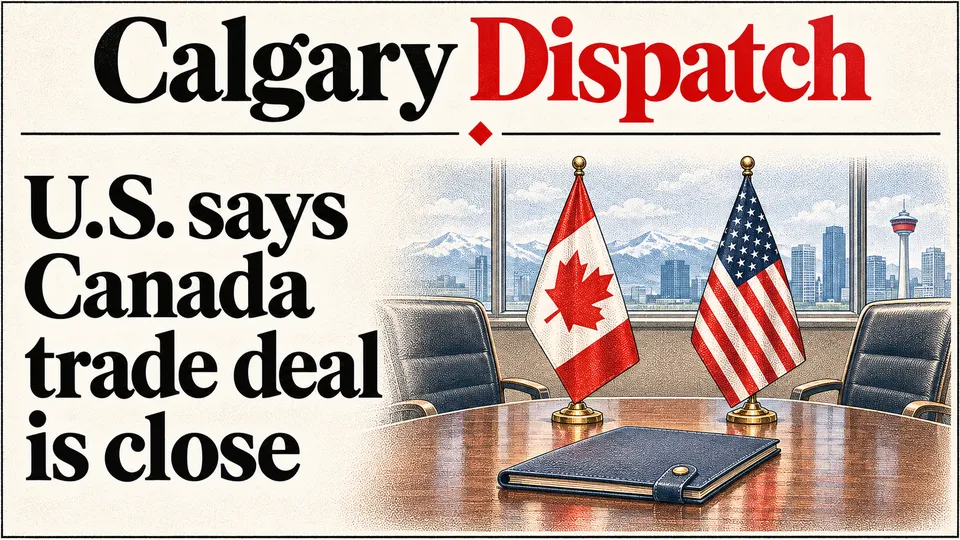
U.S. Trade Representative Jamieson Greer said Sunday that Canada and the United States are “fairly close” to a trade agreement, the most upbeat public signal from Washington in weeks as Ottawa continues to seek tariff relief for steel, aluminum, automobiles and lumber. “We’ve made a lot of progress. I think we’re fairly close on finding a landing zone,” Greer told Fox News, adding that officials are “still having constructive conversations” and “trying to square the circle” between the two economies.
The comments come after talks collapsed in August, when Prime Minister Mark Carney said Ottawa walked away from last-minute U.S. terms that included restrictions on Canada entering new trade deals with other countries. Both sides have returned to the file this month after Republicans lost control of the U.S. House and Senate in the midterm elections. Carney and U.S. President Donald Trump discussed the negotiations last week on the margins of the APEC meetings in Shenzhen, China, but announced no agreement. Carney’s office said the leaders talked about work toward a “mutually beneficial” deal that would “fully respect Canada’s languages, culture, and sovereignty.”
At a White House news conference Friday, Trump said more work remains but that the two countries are “working on making a deal that’s fair.” He said Carney “was very nice” and that “one of the things he wants to do is build a Keystone pipeline for us — and we like that,” before adding that Canada would have to “do a lot more than that.” Trump again argued the United States does not need Canadian energy, vehicles or lumber. No new pipeline approval was announced.
Major issues remain unresolved. Canada’s chief trade negotiator, Janice Charette, told a federal advisory committee that multiple trade issues are still outstanding, according to sources briefed on the meeting who spoke to Global News. Those sources said the biggest remaining obstacle is the 25 per cent U.S. tariff on Canadian automobiles, a dispute that helped bring the August talks down. Greer said Ottawa’s recent reset of trade ties with China has given Washington “concern,” particularly Canada’s decision to allow 49,000 Chinese electric vehicles a year into the Canadian market at a lower tariff rate.
Canada-U.S. Trade Minister Dominic LeBlanc said Thursday that Ottawa is seeking an interim arrangement that would lower Section 232 tariffs on steel, aluminum, autos and lumber and remove Section 338 tariffs imposed in September. He said an interim deal could also open a formal review of the Canada-U.S.-Mexico Agreement. Sources have told CBC News that Ottawa hoped to reach an arrangement by the end of the year, but LeBlanc said that is not a hard deadline: “If it takes until January or February to get that deal, we’ll do that work.”
A threatened U.S. increase in tariffs on vehicles and auto parts, to 50 per cent on Jan. 1, is also hanging over the talks. CBC News reported that Washington has not filed a formal notice of that increase, which Trump first raised in a social media post in August. Democratic Sen. Chris Coons of Delaware said Canada should take an interim deal if it can get one, then look to incoming Democratic majorities in Congress to legislate a better long-term arrangement. He called Section 232 tariffs on Canadian goods “an insult to Canada.”
For Alberta, the stakes run through energy, steel and the wider export economy. Trump treated a “Keystone pipeline” as a possible element of a deal, but he offered no terms. Greer described overall Canada-U.S. trade as “a more positive story … than people realize,” but the public comments from both capitals still point to a narrowing gap rather than a finished agreement.