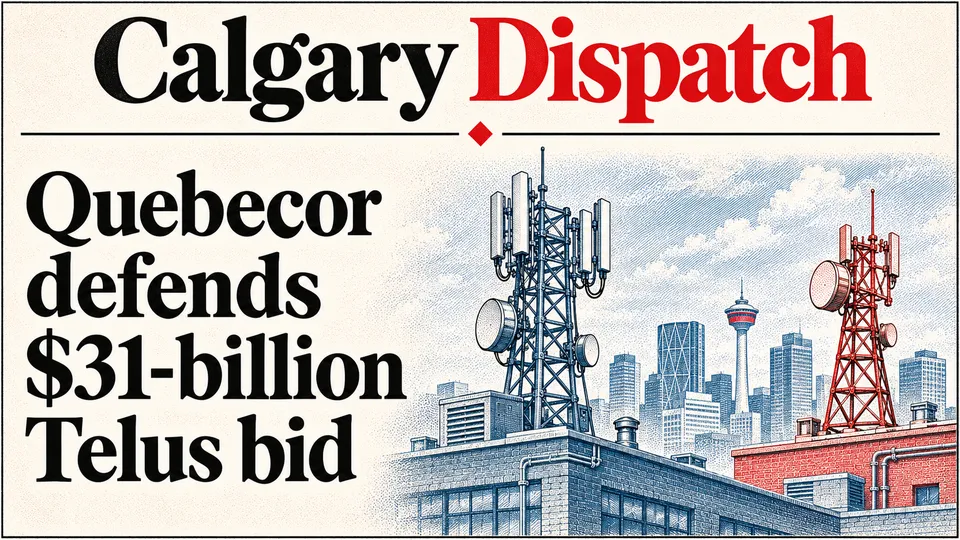
Quebecor Inc. chief executive Pierre Karl Péladeau on Sunday defended his company’s unsolicited $31-billion proposal to acquire Telus Corp., arguing the deal would protect Canadian control of telecommunications assets and would not reverse the wireless price cuts he attributes to Quebecor’s earlier purchase of Freedom Mobile. “Telecom assets are strategic for our country — we all know this,” Péladeau said in an interview on CBC’s Rosemary Barton Live. He said Quebecor has served the Freedom Mobile customer base “pretty efficiently,” and asked, “Why would you change a successful strategy?”
The Montreal-based company said on Nov. 16 that it first sent Telus a written, non-binding proposal in June and submitted an enhanced offer on Nov. 9. Under the enhanced terms, Telus shareholders would receive $6.35 in cash and 0.17 Quebecor shares for each Telus share, a package Quebecor valued at a roughly 60 per cent premium. Quebecor, now Canada’s fourth-largest telecom company, had a market capitalization of about $14.77 billion, compared with Telus’s $21.72 billion; a combination on those figures would make Quebecor larger than Rogers or Bell by market cap. Quebecor says it would keep the Telus brands and the company’s Vancouver headquarters.
The bid is the most significant proposed shakeup in Canadian telecom since Ottawa approved Rogers Communications’ acquisition of Shaw in 2023, a deal that required Rogers to sell Freedom Mobile to Quebecor in order to preserve a four-player wireless market. Critics say a Quebecor-Telus combination would shrink that market again. Canada’s annual telecom price report found that consumer cellular prices, after declining in recent years, ticked back up in 2025, and that Canadian wireless prices remain among the highest in the developed world.
Telus has formed a special committee of independent directors, chaired by board chair John Manley, to review the proposal and consider other strategic alternatives. In a Nov. 16 statement, Manley said the review had already “surfaced a number of significant risks,” including that “more than four months after its initial proposal, Québecor has yet to explain how what it is proposing could be approved under the current telecom regulatory framework in Canada.” He said a regulatory review would be “a long and costly process for our shareholders,” and that Telus also takes issue with how the proposal values the company.
Any transaction would need approval from the Competition Bureau, the CRTC and Innovation, Science and Economic Development Canada. Industry Minister Mélanie Joly said the government would not predetermine the outcome and that the reviews would be “independently and rigorously” conducted. Prime Minister Mark Carney declined to comment directly on the proposal, but said more competition, lower prices and better service would guide any decision, and that in some market structures an oligopoly can, in his view, produce more competition with fewer players. He did not elaborate.
Opposition leaders were more direct. Conservative Leader Pierre Poilievre said Friday his party had not yet seen the proposal but would judge it on whether it lowers prices for consumers. He criticized Carney’s comments, saying he had never seen “any economist anywhere in the world say that oligarchies ultimately bring prices down.” NDP Leader Avi Lewis has called on the Competition Bureau to block the sale, arguing it would raise costs and lead to layoffs. “We already pay some of the highest cellphone prices in the world,” he said.
Péladeau rejected the idea that three large Canadian carriers would leave consumers with too little choice, pointing to satellite internet providers such as Elon Musk’s Starlink as additional competition. The proposal remains non-binding, Telus has not accepted it, and the regulatory path is uncertain. For customers in Calgary and the rest of Western Canada, Telus is still an independent company.