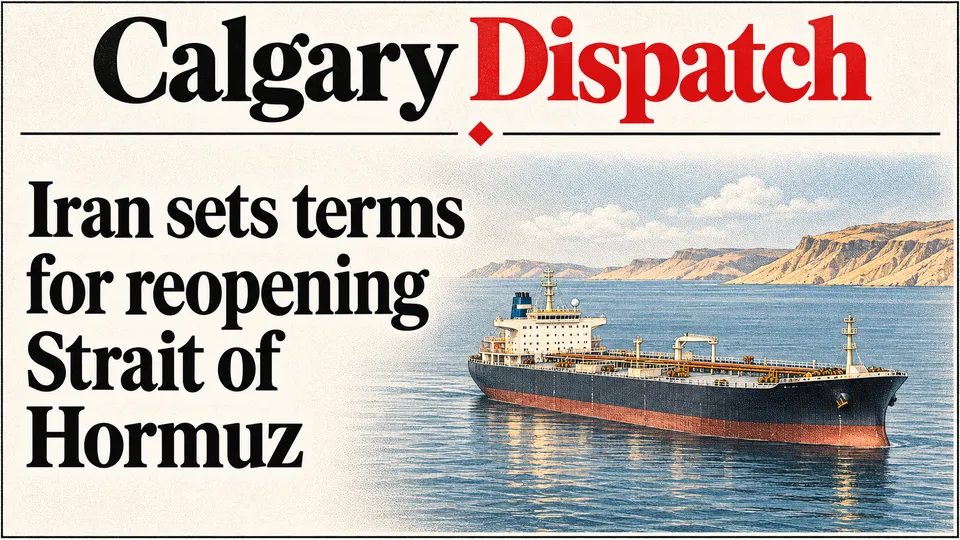
Iran said Saturday that Qatari mediators had held talks in Tehran on reopening the Strait of Hormuz, while U.S. President Donald Trump said he wants a “permanent” deal that would stop Iran from obtaining a nuclear weapon. No agreement was announced, and Iranian officials said discussions about the strait are pointless until Washington accepts Tehran’s conditions.
Deputy Foreign Minister Kazem Gharibabadi said a Qatari delegation visited Tehran on Friday night and held about two hours of talks, according to the semi-official Tasnim news agency. “We are in contact with mediators, including the Qataris, both in person and virtually, and are holding the necessary discussions to see whether another opportunity can be given to diplomacy,” he said. He added that the talks have not yet become formal negotiations. If they do, he said, technical details of Iran’s nuclear program would be discussed, but Iran’s position is that its enriched uranium must not leave the country.
Foreign Minister Abbas Araghchi said Iran is ready for dialogue and that reopening the strait is “not difficult” if the United States accepts “reasonable conditions that are in accordance with international law.” He was also blunt about the sequencing. “Our position is clear: as long as Iran’s demands are not met, the discussion on the Strait of Hormuz and its opening is pointless,” he said, according to Iranian state television. Tehran’s conditions have included ending the war on all fronts, unfreezing Iranian assets, lifting oil sanctions and ending the U.S. counter-blockade of Iranian ports. Gharibabadi said Iran regards the U.S. economic blockade as an act of war and will “take any action necessary” to break it.
Trump, speaking to Fox News on Saturday, described Iranian officials as “very, very difficult” and said he wants a deal that would remain in place even under a future president. “We make a deal, and then they break the deal the next day,” he said. The comments underline how far apart the two sides remain more than eight months after the United States and Israel attacked Iran on Feb. 28, prompting Iranian strikes on Israel and on Gulf states that host U.S. military bases. The conflict has disrupted shipping and pushed up global energy prices. Iran has restricted traffic through the Strait of Hormuz, a waterway that normally carried about a fifth of the world’s oil, and the United States has imposed a naval blockade on Iranian ports in response.
The diplomatic track is running alongside continued military signalling. The commander of Iran’s Islamic Revolutionary Guard Corps, Maj.-Gen. Ahmad Vahidi, toured an underground missile facility on Saturday and was briefed on the force’s readiness, Tasnim reported. Iranian President Masoud Pezeshkian told a meeting of investors that the country is facing a “silent economic war” that is “tougher than a war with missiles.”
For energy markets, and for oil-producing provinces such as Alberta, the immediate issue is whether a diplomatic opening can restore more normal flows through Hormuz. A reopening would ease a supply risk that has hung over crude prices since the winter. A breakdown in the talks, or a new military escalation, would do the opposite. So far, mediators have produced contact rather than terms both sides will accept. Iran says the strait can be opened quickly if its conditions are met. Washington has not publicly accepted those conditions, and Trump’s demand for a lasting nuclear agreement goes well beyond a temporary truce at sea.