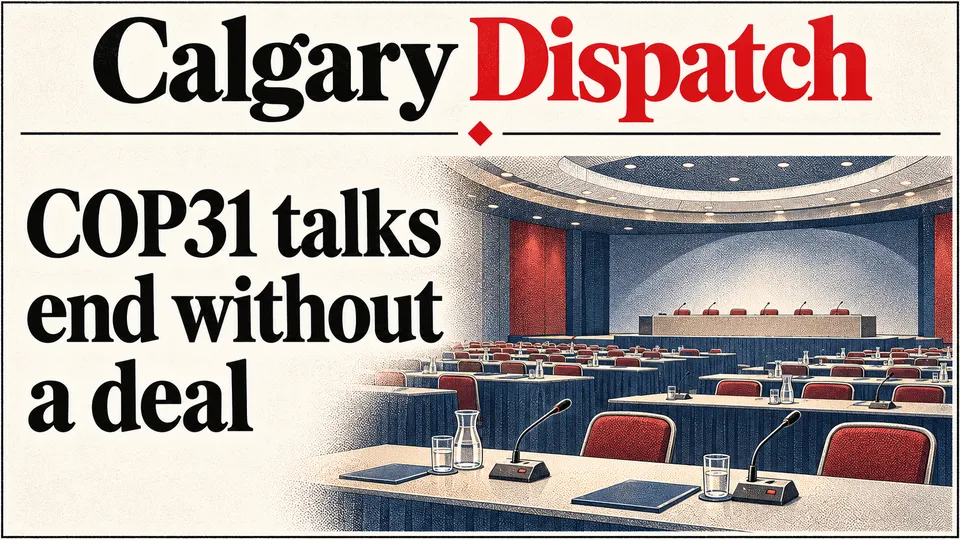
United Nations climate talks in Antalya, Türkiye, ended Sunday without an overarching political agreement, after two weeks of negotiations and two days of overtime failed to resolve a fight over fossil fuels and climate finance. COP31 President Murat Kurum, Türkiye’s environment minister, told the closing session there was “no agreement on this text” and that the decisions had not been adopted. It was the longest UN climate summit on record, and the first collapse of a COP’s main political deal since Copenhagen in 2009.
The immediate stumbling block was language. A draft presented in the early hours of Sunday did not use the words “fossil fuels” at all. The only indirect reference to coal, oil and gas was a nod to the COP28 agreement in Dubai in 2023, when countries pledged to “transition away” from fossil fuels in energy systems. A first draft earlier in the talks had mentioned fossil fuels six times, the BBC reported, but that wording was unacceptable to oil-producing nations. The European Union formally objected. Irish Minister Darragh O’Brien, speaking for the EU, said it was “unconscionable that we would have a climate pact that makes no mention of fossil fuels.” Panama and the Marshall Islands also withheld support.
Money was the other unresolved fight. At COP30 in Brazil last year, countries agreed to triple finance to help poorer nations adapt to climate impacts. This year’s draft contained no concrete figures and no baseline for that pledge, raising fears among developing countries that richer nations would be left with too much discretion. UN Secretary-General António Guterres, in his last COP before he steps down, said he was “deeply disappointed.” “There may be no consensus in the negotiating room. There is no ambiguity in the science,” he said, warning that the world is on course to exceed the 1.5 C warming limit. He argued that fossil fuels remain the primary driver of global warming and said, “We can’t put out the fire while pouring fuel on it.”
Oil-exporting countries defended a different approach. Saudi Arabia, speaking for the League of Arab States, supported references to carbon capture and storage and said all viable climate solutions should remain on the table. Russia, according to the BBC, warned against turning to “slogans” over coal, oil and gas and argued that moving away from fossil fuels too quickly would lead to “fuel poverty.” Australian minister Chris Bowen, who served as president of negotiations, pointed to “unbridgeable red lines” and “the most complicated and fraught geopolitical environment in living memory.”
The failure of the main “cover decision” does not wipe out every outcome from the conference. Delegates did make progress on a “just transition” mechanism intended to support workers and communities as economies shift, and Kurum said more than 80 countries backed Türkiye’s target of raising the share of global energy use met by electricity to 35 per cent by 2035. UN climate chief Simon Stiell said the world “cannot afford a repeat of this moment.” He told the BBC he would seek advice on possible reform of the consensus-based system. The next conference, COP32, is scheduled for Addis Ababa in November 2027.
Canada did not issue an immediate reaction to the collapse on Sunday. In its national statement on Nov. 18, Ottawa said exceeding 1.5 C of warming is “widely seen as unavoidable,” while arguing that “climate action and economic growth must advance together.” Officials pointed to a plan to double Canada’s electricity supply by 2050 and a $13-billion climate-finance commitment over five years. For Alberta, a major oil and gas producer whose government is also pushing new export pipelines, the impasse leaves the international rules of the energy transition no clearer than when the talks began.