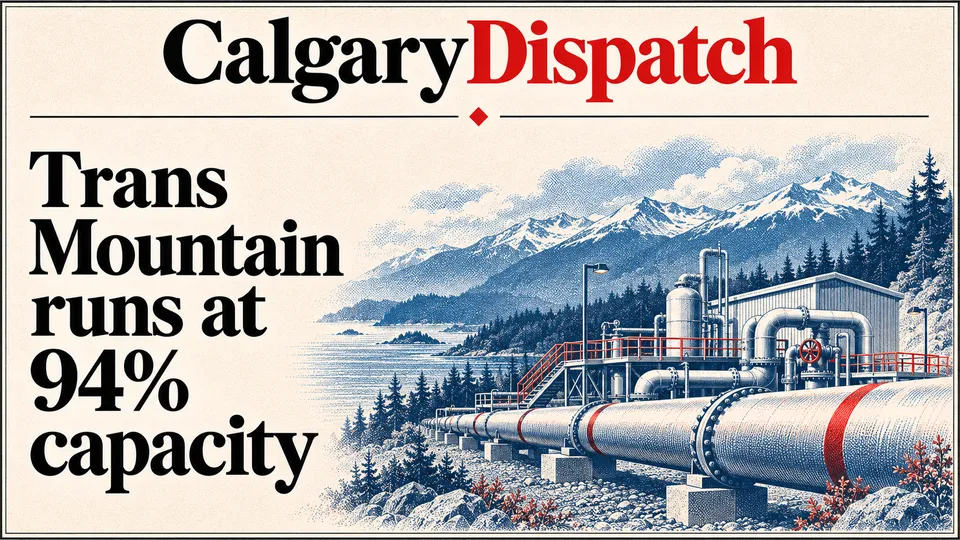
Calgary-based Trans Mountain Corporation reported increasing pipeline utilization and revenue Friday, November 27, alongside progress toward expanding Canada's oil transportation capacity to the Pacific Coast. The federally owned company announced that shipments averaged 840,000 barrels per day during the third quarter, representing 94 per cent of its nominal capacity during the reporting period. That compares with average daily shipments of 777,000 barrels during the corresponding quarter of 2025.
Third-quarter revenue increased from $765 million to $825 million, while net income rose from $127 million to $132 million. Adjusted earnings before interest, taxes, depreciation and amortization reached $600 million. Although quarterly earnings improved, net income for the first nine months declined to $367 million from $425 million in the previous year, reflecting increased depreciation and amortization expenses, among other factors.
Trans Mountain also reported payments totalling approximately $1.45 billion during the first nine months to Canada TMP Finance, the entity holding the federal government's investment. Those payments consisted of interest, dividends and returns of capital. They should not be interpreted as equivalent to net profit or as evidence that the federal government's original acquisition and expansion expenditures have been recovered.
The company's latest operational developments could provide additional transportation capacity for Alberta producers. Trans Mountain says its drag-reducing agent project was completed and commissioned two months ahead of schedule. The improvement increases potential system capacity from 890,000 to 980,000 barrels per day. Regulatory approvals are already in place, with additional contracted transportation service expected to commence in stages beginning January 1, 2027.
A separate mainline optimization proposal would add another 210,000 barrels of daily capacity. If approved and completed as anticipated, the two projects would increase the system's nominal capacity to approximately 1.19 million barrels per day by the end of 2028. That larger expansion remains subject to regulatory proceedings and project execution.
Demand for additional transportation capacity appears substantial. Trans Mountain says its summer contracting process attracted bids for nearly 400,000 barrels per day against 72,000 barrels of available incremental firm capacity. In September, the Canada Energy Regulator separately approved a negotiated settlement governing tolls, tariffs and transportation services.
For Alberta, the results demonstrate the continuing commercial significance of access to Pacific export markets. They also provide context for the proposed Pacific Link pipeline and further oilsands investment. However, increased pipeline utilization does not automatically establish the financial viability of every proposed expansion. Future transportation demand, construction costs, regulatory approvals and the economics of alternative export routes will determine the value of additional infrastructure.
Sources: Trans Mountain Corporation Q3 results · Canada Energy Regulator: Trans Mountain tolls settlement