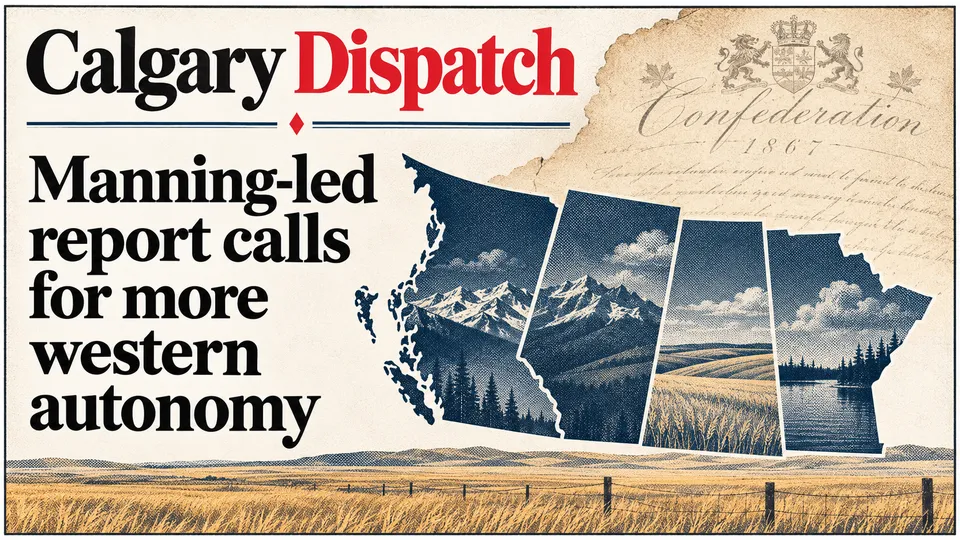
A report presented in Calgary on Tuesday is urging Alberta and other western provinces to pursue greater provincial authority through coordinated action within Confederation rather than seek separation from Canada.
The recommendations emerged from the Alberta and the West Assembly, which convened an online conference in September. Former Reform Party leader Preston Manning and former British Columbia Liberal premier Gordon Campbell chaired the initiative. According to Canadian Press reporting on the November 17 presentation, participants examined ways the western provinces could strengthen their influence in federal-provincial negotiations.
Among the ideas reported are closer cooperation among British Columbia, Alberta, Saskatchewan and Manitoba, a review of areas where federal and provincial jurisdiction overlap, and consideration of an immigration agreement modelled on the 1991 Canada–Quebec accord. The report also points to Quebec’s efforts to secure greater authority within the federation while distinguishing that approach from secession.
The proposals follow Alberta’s October 19 referendum, in which voters rejected launching a process toward a subsequent binding separation vote. The assembly’s recommendations therefore offer one possible route for governments seeking additional provincial powers without reopening the independence question. They are proposals from a non-governmental initiative, not adopted policy or a binding interprovincial agreement.
A central unanswered question is how the four western provinces would reconcile their different political and economic priorities. Any effort to expand provincial authority would also need to account for constitutional limits, federal responsibilities, Indigenous and treaty rights, and areas in which formal agreements would be needed. Manning said he intends to seek responses from federal and provincial elected representatives, according to the Canadian Press.
For Alberta, the practical test will be whether the recommendations lead to concrete negotiations or remain a statement of political objectives. The province already has a crowded federal-provincial agenda involving energy, immigration and infrastructure. A detailed comparison of the proposals with existing agreements and constitutional powers would be more useful to voters than treating calls for western unity as a new government program.