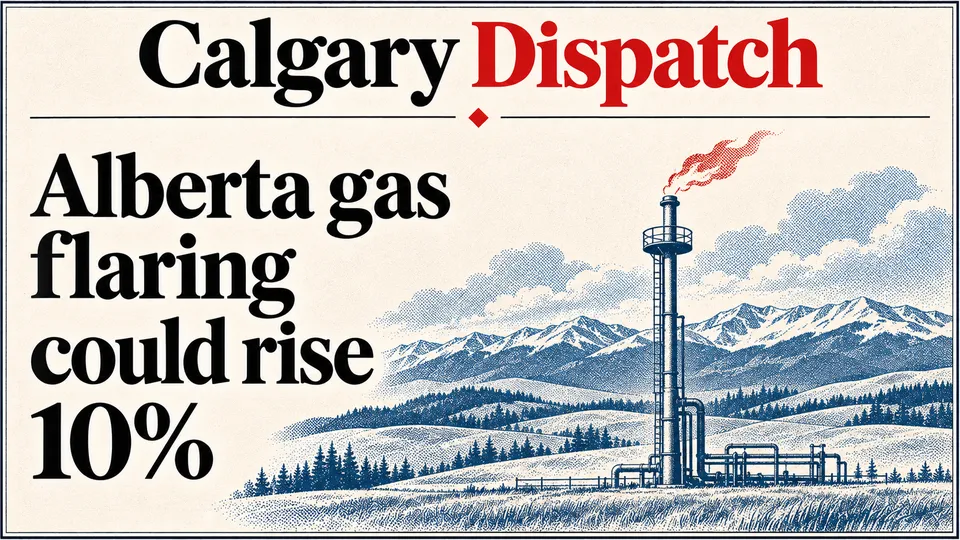
Natural gas flaring is rising again in Alberta, creating renewed questions about the relationship between growing oil production and the province's environmental regulations. An analysis published Tuesday, November 24, by Reuters, using Alberta Energy Regulator data, found that producers are on course to increase annual flaring volumes by approximately 10 per cent in 2026. The projected increase follows a decline of approximately 15 per cent in 2025.
Reuters reported that Alberta producers flared 644 million cubic metres of natural gas during the first nine months of 2026. The former annual regulatory limit was 670 million cubic metres, meaning reported volumes were already approaching that historical threshold by the end of September. Alberta removed the province-wide solution gas flaring limit in June 2025. Exceeding the former threshold would therefore not, by itself, constitute a violation of the current regulatory framework.
Flaring is the combustion of natural gas that is not captured for sale or productive use. The practice releases carbon dioxide and other pollutants, although combustion can produce a lower climate impact than releasing the methane directly into the atmosphere through venting. Flaring can also be necessary for operational safety. The environmental and economic questions therefore involve the circumstances under which gas is burned, the availability of conservation alternatives and the performance of individual facilities.
The Alberta Energy Regulator continues to impose operational requirements through Directive 060, which addresses flaring, incineration and venting. Its March 2026 revisions introduce additional requirements involving flare ignition systems, monitoring and maintenance, with several measures scheduled to begin in 2030. The removal of the province-wide volume limit did not eliminate all regulatory obligations governing the practice.
The latest figures arrive as Alberta and Ottawa continue developing a new methane equivalency agreement. Federal regulations scheduled to begin taking effect in 2028 are intended to strengthen emissions controls. Under the existing agreement-in-principle, Alberta could apply its own regulatory approach instead, provided it delivers the required environmental outcomes. The governments have identified a target of reducing methane emissions by 75 per cent from 2014 levels by 2035.
For Calgary's energy companies, reducing avoidable flaring could represent both an environmental improvement and an opportunity to recover gas that would otherwise be lost. However, the commercial feasibility of capturing that gas depends on its volume, location, processing requirements and access to transportation infrastructure. The latest figures are particularly relevant as Alberta considers additional natural gas transmission capacity and encourages new industrial consumption. Final 2026 statistics and facility-level reporting will be needed to determine whether the projected increase is sustained and which operations are responsible for the largest changes.
Sources: Reuters: 2026 flaring analysis · Alberta Energy Regulator: removal of solution gas flaring limit · Alberta Energy Regulator: Directive 060