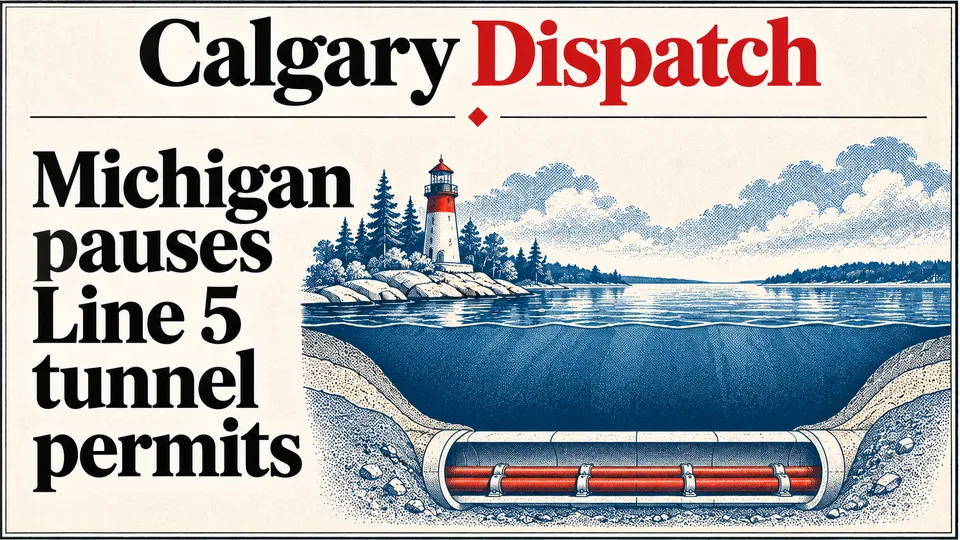
Calgary-based Enbridge is facing another regulatory setback in its efforts to construct a tunnel for its Line 5 pipeline beneath the Straits of Mackinac. Michigan Governor Gretchen Whitmer announced Tuesday, November 24, that the state's Department of Environment, Great Lakes, and Energy must suspend further action involving environmental permits for the proposed Great Lakes Tunnel until outstanding legal questions are resolved.
Whitmer's directive follows a Michigan Supreme Court ruling that overturned a separate approval issued by the Michigan Public Service Commission in 2023. The court concluded that the commission's review had not adequately considered certain environmental consequences and returned the matter to the regulator for reconsideration. The governor's latest decision pauses additional environmental permitting activity while those issues remain unresolved. It does not constitute an immediate shutdown order for the existing Line 5 pipeline.
Line 5 runs approximately 1,038 kilometres from Superior, Wisconsin, to Sarnia, Ontario. The Canada Energy Regulator puts its capacity at up to 540,000 barrels per day of light crude oil and natural gas liquids. Its position within the broader North American pipeline network makes it relevant to Alberta producers, Ontario refineries and consumers in the Great Lakes region. The proposed tunnel would accommodate a replacement section beneath the lakebed rather than eliminate the entire existing transportation route.
Enbridge maintains that placing the replacement pipeline within a tunnel would improve environmental protection and preserve regional energy supplies. The company secured a federal construction-related authorization from the United States Army Corps of Engineers in August. However, Enbridge's own project announcement acknowledged that state approvals are also required. Federal authorization therefore does not resolve the outstanding Michigan permitting issues.
Opponents of the tunnel have raised concerns about potential environmental damage, continued dependence on fossil fuel infrastructure and impacts on Indigenous interests within the Great Lakes. Whitmer has emphasized the risks associated with a potential pipeline spill. Enbridge, meanwhile, has defended the technical and environmental reviews already undertaken and warned that the latest legal developments create further uncertainty for the project.
For Alberta's energy industry, the dispute illustrates the continuing risks associated with transportation infrastructure that crosses international boundaries. An eventual interruption of Line 5 could affect supply arrangements serving Central Canada, although Thursday's available evidence does not establish an imminent interruption or a measurable effect on Alberta crude prices. The next significant milestones will be the Michigan Public Service Commission's reconsideration of the project, clarification of the suspended environmental permitting process and any revised construction schedule issued by Enbridge. The latest decision adds uncertainty to the tunnel's development but should not be interpreted as confirmation that the existing pipeline will cease operations.
Sources: Michigan governor’s directive; Michigan Supreme Court ruling; Canada Energy Regulator pipeline profile; Enbridge federal permit announcement.