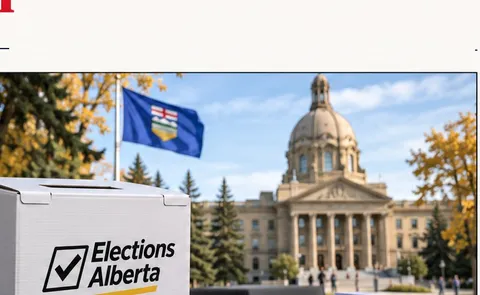
Alberta Premier Danielle Smith is signalling that her government will likely introduce legislation in spring 2027 requiring voters to provide documentary proof of Canadian citizenship before casting ballots in provincial elections. Speaking during a virtual United Conservative Party members' town hall on Saturday, November 21, Smith indicated that the government intends to act on a proposal endorsed by voters in October's referendum. Her remarks, reported by the Canadian Press on November 22, suggest the changes could be in place before Alberta's next scheduled provincial general election on October 18, 2027. No legislation has yet been introduced.
The proposal originates from one of the 10 questions presented to voters in the October 19 referendum. Albertans were asked whether they supported requiring proof of citizenship, such as a passport, birth certificate or citizenship card, to vote in provincial elections. Official Elections Alberta results show that approximately 58.06 per cent of valid votes supported the proposal, compared with 41.94 per cent opposed. The question was explicitly non-binding, meaning the referendum result did not automatically change election law. Legislative action would still be necessary.
Smith told party members that voters should prepare to bring citizenship documents or one of Alberta's redesigned provincial identification cards displaying a citizenship marker. The government argues that the additional requirement would strengthen confidence in the electoral process by verifying that individuals are eligible to vote. Canadian citizenship is already a legal requirement for provincial voting, and voters currently must meet Elections Alberta's identification and registration requirements. The proposed policy would add a specific documentary verification step rather than create the underlying citizenship eligibility rule. The proposal has attracted criticism over its potential effect on accessibility. Opponents argue that some eligible Canadian citizens may not possess a passport, readily available birth certificate or other qualifying document. People born outside Canada, residents dealing with incomplete historical records and individuals experiencing administrative delays could face additional barriers.
Alberta's recent redesign of identification documents has already generated complaints from residents whose supporting records were difficult to obtain. The province subsequently announced temporary measures intended to address some of those difficulties. Mail-in voting could also be affected. Smith indicated that the government may need to reconsider access to special ballots if citizenship verification requires an in-person process. That possibility matters because Elections Alberta reports that special ballots accounted for approximately 29.4 per cent of ballots cast across the October referendum questions. Those figures do not establish how many voters would lose access under a future law, but they demonstrate that remote voting is a substantial component of Alberta's election system.
The central question is how the government would implement its stated objective without preventing eligible citizens from exercising their voting rights. Legislation would need to identify acceptable documents, specify procedures for people whose records are unavailable and determine whether alternative verification processes would exist. The government would also need to establish procedures for advance voting, special ballots and mobile polls serving hospitals, long-term care facilities and other locations. With a general election scheduled for October 2027, the time between a proposed spring bill and implementation would be relatively short. The exact requirements remain unknown until the legislation is introduced.