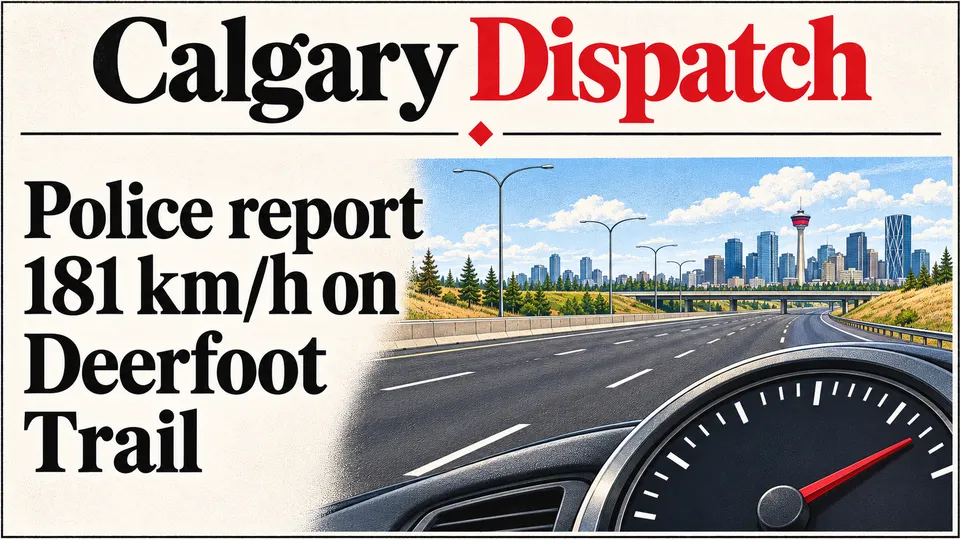
Calgary police are highlighting an excessive-speed incident on Deerfoot Trail after officers stopped a vehicle travelling 181 kilometres per hour in a posted 110-kilometre-per-hour zone. The traffic stop occurred Sunday, November 15, but police publicly reported the incident on November 22 as part of their road-safety messaging. The vehicle was allegedly travelling 71 kilometres per hour above the speed limit. Police say the driver received an $852 ticket for careless driving and was also summoned to appear in court on a speeding allegation.
The police statement did not publicly identify the driver, specify the exact stretch of Deerfoot Trail involved or describe the circumstances immediately preceding the traffic stop. It also did not report a collision or injuries connected to the incident. The information establishes that officers conducted enforcement and issued a ticket and court summons; it does not establish that a court has found the driver guilty of the speeding allegation. Alberta's speeding penalty system distinguishes between violations that can generally be resolved through a preset fine and more serious cases requiring judicial consideration. According to the provincial government's published fine schedule, a driver detected travelling 51 kilometres per hour or more above the posted limit must appear in court, where the speeding fine is determined at the court's discretion. The standard fine schedule lists amounts for violations up to 50 kilometres per hour over the limit. As a result, the $852 amount reported by police is the careless-driving ticket, not the final penalty for the separate speeding matter.
The distinction is important because the financial and legal consequences of the incident have not been fully determined. A court summons creates an obligation for the driver to address the alleged offence through the judicial process. It does not establish the amount of any additional fine, whether other penalties will be imposed or how the matter will ultimately be resolved. The careless-driving ticket and speeding allegation should therefore be described separately rather than combined into a single confirmed penalty.
Calgary police used the incident to reinforce their warnings about excessive speed, particularly the reduced time available to respond to unexpected hazards and the increased seriousness of collisions at higher velocities. Deerfoot Trail carries substantial commuter, commercial and regional traffic, making speeding enforcement relevant to a broad range of road users. The police service has publicized several other recent high-speed traffic stops in Calgary, although those individual cases do not establish a citywide trend without comparative enforcement and collision data. The next meaningful legal development will be the driver's court appearance and the disposition of the speeding allegation. For a wider public-safety assessment, the more useful questions concern whether excessive-speed incidents are increasing on Deerfoot Trail, how enforcement levels have changed and whether serious collisions are concentrated in particular locations. Those questions require official traffic enforcement and collision statistics rather than conclusions drawn from a single police-reported incident.