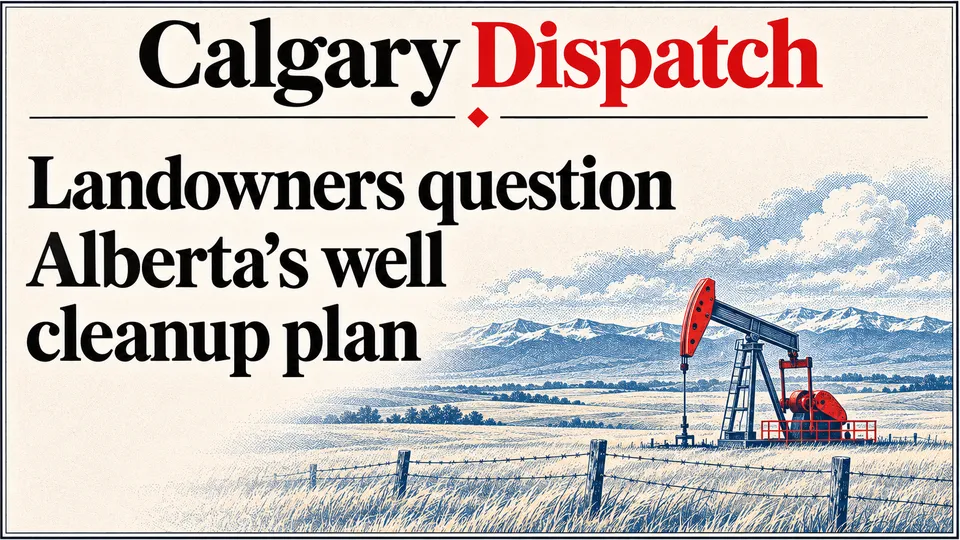
Alberta's proposed new oil-and-gas cleanup fund is receiving qualified support from landowner and environmental advocates who say the province must still confront thousands of wells awaiting decommissioning and reclamation. Introduced November 18 as part of Bill 42, the proposed legislation would require companies drilling new wells to begin setting aside money for eventual closure before the wells reach the end of their productive lives. The measure is intended to prevent future cleanup obligations from becoming unfunded liabilities, but it does not directly eliminate the existing orphan-well backlog.
The proposed Resource Asset Closure Assurance and Stewardship Fund would attach financial security to individual wells rather than simply to their current operators. According to the province, companies would make an initial payment of up to $50,000, followed by annual contributions over as many as 10 years, based on estimated future closure costs. If a well changed ownership, its associated funding would follow it.
If the operator failed and the well became orphaned, the funding would become available to the Orphan Well Association for cleanup. The requirements are expected to apply to wells drilled after April 1, 2027, provided the legislation passes and implementation rules are finalized. Bill Heidecker, president of the Alberta Surface Rights Federation, told the Canadian Press that the proposal was a step in the right direction but raised questions about enforcement and the calculation of cleanup costs.
Heidecker, a rancher near Coronation, has extensive experience dealing with producing and inactive wells on agricultural land. He questioned whether the contributions would adequately cover future reclamation expenses and whether regulators would enforce the obligations consistently. Environmental organizations have also distinguished the proposed funding model from the broader challenge of aging energy infrastructure.
The Pembina Institute described the measure as a positive development while calling for additional action on inactive and orphan wells, including stronger timelines and financial requirements. Those concerns reflect a central limitation of the proposal: setting aside money for new drilling does not automatically fund closure of older wells whose operators may no longer have sufficient resources. The scale of the existing challenge remains substantial.
The Orphan Well Association's figures cited in Canadian Press reporting identified 7,328 wells awaiting decommissioning and another 9,258 sites requiring reclamation. Its 2026–27 industry levy is approximately $155 million, while estimated cleanup costs for its inventory total about $1.66 billion. The association's historical figures also show that average combined decommissioning and reclamation costs exceeded $56,000 in its 2025–26 fiscal year, although costs vary considerably by site.
These figures describe different stages of the closure process and should not be added together as a count of distinct wells. Energy and Minerals Minister Brian Jean has argued that the new system would make cleanup funding a routine cost of drilling, with money potentially returned to companies once reclamation is completed. The province's objective is to prevent a repeat of the financial problems associated with aging wells, not to retroactively finance every existing liability.
The key tests will be whether the legislation passes, how regulators calculate security requirements, how payments are enforced and whether Alberta introduces separate measures to reduce the historical cleanup backlog.